Help Build the Michael Kováts Memorial
Help honor Revolutionary War hero Colonel Michael Kováts, founder of America’s cavalry tradition. Support a bronze equestrian statue in Charleston, where he gave his life for liberty in 1779.
About
Michael Kováts crossed the Atlantic in 1777 to fight for American independence. Working alongside General Casimir Pulaski, he helped organize and train America's first effective cavalry force. Kováts was killed leading a charge near Charleston on May 11, 1779. We seek to honor his sacrifice with a life-size bronze equestrian statue in Charleston for America250. Help us raise the first $250,000 toward this lasting tribute to courage, freedom, and international friendship.
“A famous Hungarian to who American history owes so much.”
- Ronald Reagan
Become an America250 Founding Supporter
All donors contributing $250 or more will be recognized as America250 Founding Supporters of the Michael Kováts Memorial and listed on the project website (www.MichaelKovats.com) unless they prefer to remain anonymous. Major donors, foundations, corporations, veterans organizations, and historical societies interested in partnership opportunities are encouraged to contact the Michael Kováts Memorial Committee directly via Anna Smith Lacey (anna.smithlacey@hungaryfoundation.org)
Who Was Michael Kováts?
Inspired by the cause of American independence, Kováts crossed the Atlantic in 1777 and offered his sword to the Continental Army. General George Washington personally met Kováts and later assigned him to assist General Casimir Pulaski in organizing and training America's first effective cavalry force. Together, the Polish-Hungarian duo created Pulaski's Legion, one of the most celebrated and internationally diverse units of the Revolutionary War. A contemporary American officer described Kováts' cavalry as "the best cavalry the rebels ever had." Today, Pulaski is remembered as the Father of the American Cavalry. Yet the man who helped recruit, train, and lead those horsemen remains largely unknown.
Why Charleston?
Charleston is where Kováts made the ultimate sacrifice for American independence. Leading a cavalry charge against British forces outside the city, he was killed in action on May 11, 1779. No place is more fitting for a permanent memorial to this Revolutionary War hero.
The Memorial
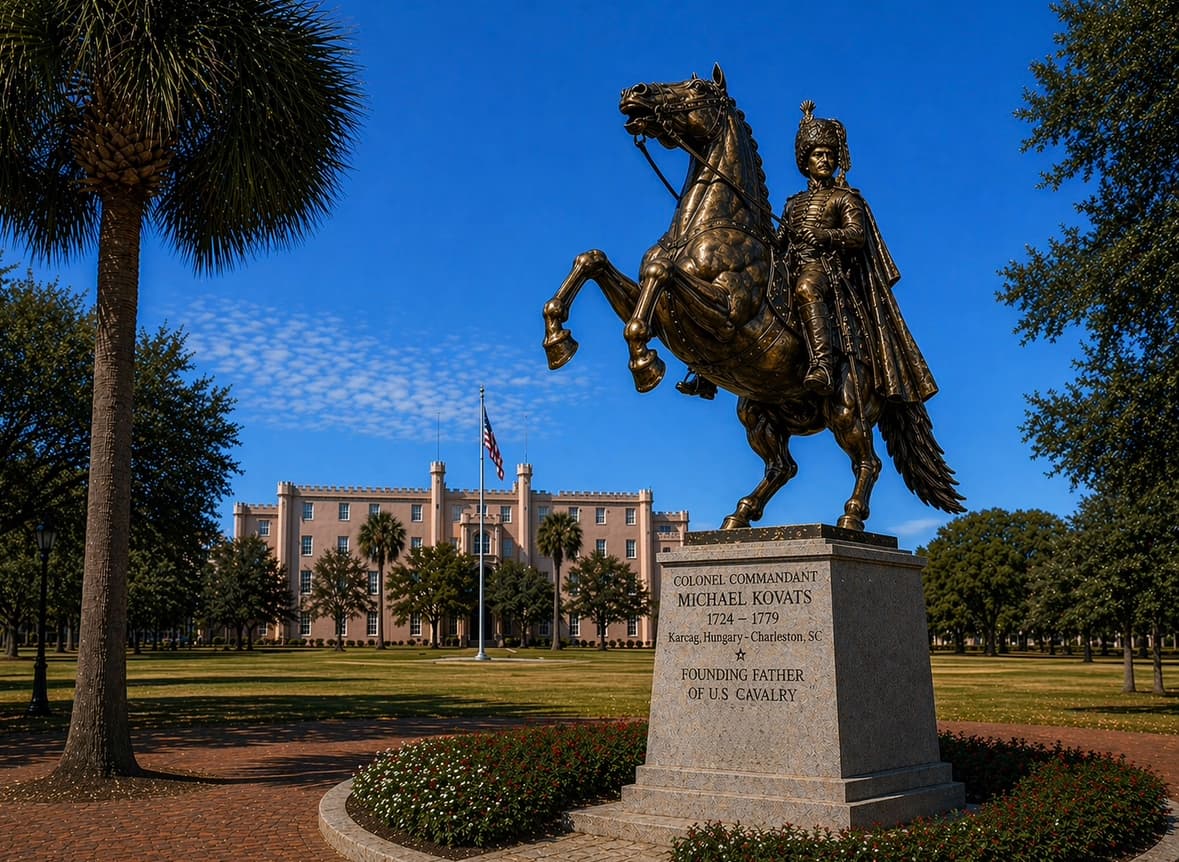
The proposed monument will be a life-size bronze equestrian statue created by acclaimed Hungarian sculptor Botond Polgár and installed in Charleston as a lasting public tribute.
The memorial will serve as:
* An America250 legacy project
* A tribute to Revolutionary War service
* A celebration of America's international friendships
* An educational landmark for students and visitors
* A symbol of the enduring bond between Hungary and the United States
Why This Matters
Michael Kováts left behind his homeland, crossed an ocean, and ultimately gave his life for a country that was not yet his own because he believed that freedom was worth fighting for. His story reminds us that America's founding ideals inspired people far beyond its shores—and continue to do so today.
Activity
Help Us Reach Our First Goal
The total project cost is estimated at approximately $1 million. Our immediate goal is to raise $250,000 to complete the design phase, begin casting preparations, secure critical project commitments, and demonstrate the public support needed to unlock additional funding from foundations, corporations, veterans organizations, and historical societies. Every contribution moves the project closer to completion.
Join Us
The America250 anniversary is approaching quickly, and the opportunity to create this lasting tribute will not wait. Michael Kováts helped build America's first cavalry force and gave his life for the cause of freedom. Now it is our turn to ensure his story is remembered. Donate today and help build the Michael Kováts Memorial in Charleston for America250.
About the Campaign
The Michael Kovats Statue Fund is administered by the Hungary Foundation, a nonprofit organization recognized as tax-exempt under Section 501(c)(3) of the Internal Revenue Code. Contributions to the campaign are tax-deductible to the fullest extent permitted by law.