
New Dog, New Challenge! Raising Funds for AHC Rehabilitation Facility Dog Program
Help Dr. Kirsten Ricci Raise Funds for Adventist HealthCare’s Facility Dog Program I’ll climb, you contribute what you can to support our rehabilitation facility dog program.
Challenge One – July 10 – 12 – Three mountain marathons in three days
Day 1: 26.5 miles, 6,312 ft elevation gain/loss
Day 2: 27 miles, 6,662 ft elevation gain/loss
Day 3: 27.5 miles, 6,376 ft elevation gain/loss
Challenge Two – August 22 – 23 – Climbing 29,029 ft., the equivalent of Mt. Everest’s vertical elevation
Marcy has joined Peru. Facility dogs help people with life-altering physical obstacles recover more quickly, regain confidence and return to an active life. Your donations can have a significant impact on the lives of our patients. Please give. Funds are used for ongoing research about the benefits of facility dogs and for their continued care.
Our Facility Dogs
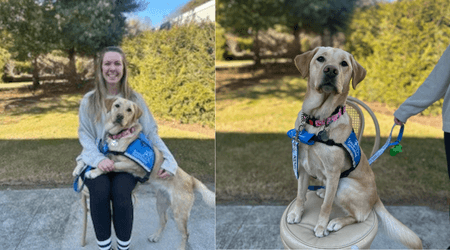
Marcy is a 2 year old female Lab Golden Cross from Canine Companions. She loves belly rubs and knows 40+ commands. She was raised in New Hampshire. She works alongside Colette Calomeris, OTD at Rockville Rehabilitation and is already making a pawsitive impact in the care of patients.
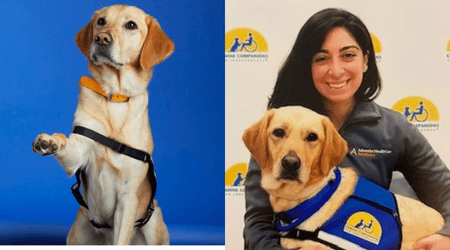
Peru is a 7 year old female Lab Golden Cross from Canine Companions. She has been working at White Oak Rehabilitation for 5 years and is a seasoned pawfessional. She was raised in Virginia. She works alongside Dr. Heather Tropiano, rehabilitation psychologist.
The Power of Facility Dogs
Unlike a therapy dog, who has a volunteer handler and provides emotional support to people served, Peru and Marcy have received rigorous training to work as a facility dog. Both Marcy and Peru were bred to be service dogs. However, after 9 months of professional training the staff realized that both Marcy and Peru would be better placed as a facility dog, helping dozens of people every week, rather than just helping one person as a traditional service dog.
“Both of these sweet ladies are extensively trained and vetted,” Dr. Tropiano said. “They also must be retested regularly to ensure they are fit for the job. Colette and I along with our dogs as individual teams also have to go through recertification every year. It’s a lot of ongoing work.”
Both Marcy and Peru are extremely smart and know many tasks to assist patients with daily tasks, including: Helping a patient take off a jacket Opening or closing drawers Pushing a button to summon an elevator Picking up dropped items, such as keys and pill bottles. During our therapy sessions, we incorporate these service dog skills into activities with our patients to help them towards a goal. For example, because our dogs are trained to push a button, we have taught them to use their nose to hit a balloon back and forth to patients working on standing, tracking, balance, coordination, etc.”
“If someone has had a stroke, getting them to stand or take their first steps can be overwhelming and anxiety-provoking,” Dr. Tropiano said. “Having Peru or Marcy work with them one-on-one can help them get closer to their rehabilitation goals without them even realizing it because they are such a novel, adorable and engaging distraction.”